

Products
NOx Sensors
Product Overview
Under increasingly strict global emissions standards, the Nitrogen Oxides (NOx) sensor has become essential for modern exhaust aftertreatment systems, particularly in diesel and lean-burn gasoline engines. While conventional oxygen sensors manage air-fuel ratios, the NOx sensor delivers direct, real-time measurement of exhaust NOx levels and also provides lambda (air-fuel ratio) information, enabling precise closed-loop emission control and compliance with On-Board Diagnostics (OBD) regulations. As a high-precision electrochemical device based on zirconia (ZrO₂) technology, it provides accurate NOx concentration data across diverse operating conditions. NOx forms under high-temperature, oxygen-rich combustion and contributes to smog, acid rain, and respiratory health impacts. By supplying continuous feedback to the engine or aftertreatment control unit, the NOx sensor allows dynamic dosing of reductant—such as aqueous urea (AdBlue®)—in SCR systems. This closed-loop operation optimizes NOx reduction and ensures compliance with worldwide emissions standards including China 6, Euro 6d, and EPA Tier 4.
Product Application
Essential for vehicles meeting China 6 / Euro 6 standards, NOx sensors enable:
- Real-time SCR control via upstream NOx measurement
- OBD-compliant verification of aftertreatment efficiency through downstream sensing
Types of NOx Sensors
FLNO-A NOx Sensor (FLNO-A)
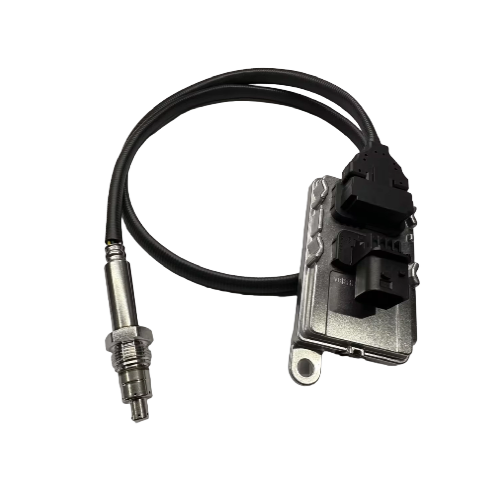
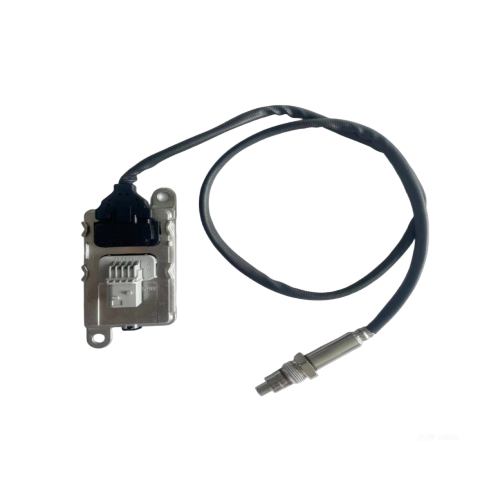
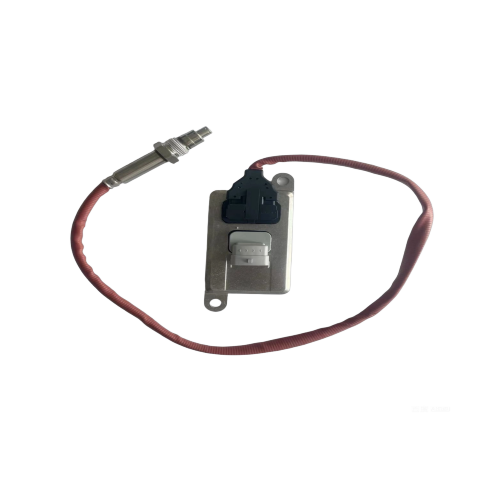
Under increasingly strict global emissions standards, the Nitrogen Oxides (NOx) sensor has become essential for modern exhaust aftertreatment systems, particularly in diesel and lean-burn gasoline engines. While conventional oxygen sensors manage air-fuel ratios, the NOx sensor delivers direct, real-time measurement of exhaust NOx levels and also provides lambda (air-fuel ratio) information, enabling precise closed-loop emission control and compliance with On-Board Diagnostics (OBD) regulations.
Product Series
Product Features & Installation
Performance Parameters
| Parameter | FLNO-A |
|---|---|
Measuring Principle: | ZrO₂-based dual-cavity sensor with integrated heater and dual amperometric pump cells (IP0 for O₂, IP2 for NOx) |
Triple Output Signal: | • NOx: 0 – 2500 ppm (NO + NO₂)
• Linear lambda (λ): Equivalent to exhaust O₂ concentration of 0–21% (λ ≈ 0.75 to lean)
• Binary lambda status: Digital rich/lean indication around λ=1, transmitted via CAN |
Measuring Range(NOx): | • 0–100 ppm: ±10 ppm
• 100–500 ppm: ±10%
• 500–1500 ppm: ±15%
•1500~2500ppm: +/-30 %
(Test gas: H₂O=3%, O₂=0–13%, balance N₂) |
Measuring Range(O2): | •0%~5% O2 ± 0.3% abs 、
•5 %~21% O2 ± 6% ref |
Time for Readiness (NOx): | <100 seconds (from power-on to valid status byte)
Typical performance: as fast as 55 seconds under standard test conditions (Tgas ≥ 250°C, Ubat = 13.5 V)
<165s Dewpoint to first signal within spec |
Supply Voltage: | 24 V DC (heater operating range: 11–32 V) |
Data Link: | CAN bus |
Sensor Protection Cover: | Specific for passenger car or Heavy-Duty Truck |
Operating Gas Temperature: | 200 - 800 °C(Range for valid measurement accuracy) |
Lifespan: | Validated by engine test (2000h equivalent to 100,000 km) |
Installation & Structure
| Parameter | FLNO-A |
|---|---|
Thread Specification | M20 × 1.5-6e |
Installation Torque | 50 ± 10 N·m(apply anti-seize compound on threads) |
Hexagon Size | 27 mm |
Operating Gas Temperature | 200 °C to 800 °C(Range for valid measurement accuracy) |
Cable Length | Multiple specifications of wiring harnesses |
Connector Type | 4/5/6pin connector(Depending on product requirements) |
SCU housing | Rectangular die-cast aluminum |
Protection Rating | IP67 (Applies to fully assembled sensor with connector mated or protected by cap) |
Grommet Working Temperature | Continuous: ≤200 °C
Short-term: 225 °C
(Material: Silicone + Fiberglass braid) |
SCU Operating Temperature | Continuous: –40 °C to +125 °C |
Connector Temp Rating | Continuous: ≤125 °C |